
Overview
- Avant STAMP is a nationally recognized web-based test that assesses language proficiency.
- Avant STAMP was originally developed by the Center for Applied Second Language Studies (CASLS), a National Foreign Language Resource Center at the University of Oregon and funded by the US Department of Education. It was later adapted and is delivered by Avant Assessment.
- Test results inform test takers and educators about learning progress and program effectiveness.
- Tests are taken in a proctored environment with no outside resources allowed.
- The test has four sections – Self-Evaluation Reading, Writing, Self-Evaluation Listening, and Speaking.
- Test takers will be asked to answer seven self-evaluation questions that best represent their skill/ability level in both the Reading and Listening sections. The self-evaluated reading score is used to determine the level of prompt delivered for the writing section. The same applies to the listening self-evaluation related to the speaking prompts. This allows the language productive sections to be more appropriately leveled for the test taker.
- Writing and Speaking responses are rated by Avant’s trained raters who use a Scoring Rubric that lists the criteria for meeting Benchmark Levels.
Avant STAMP Overview
Avant ختم WS is a web-based test that assesses language proficiency. It has 4 sections: Reading (Self-Evaluation), Writing, Listening (Self-Evaluation), and Speaking.
Writing and Speaking responses are rated by Avant Certified Raters who use a Scoring Rubric that lists the criteria for meeting Benchmark Levels.
Each test taker should read through the دليل الذي يؤدي الاختبار.

(Self-Evaluation)
7 questions

3 prompts

(Self-Evaluation)
7 questions
3 prompts
Test Rules
Tests are taken in a proctored environment with no outside resources allowed.

- Do not click outside the test window. This is tracked and will log you out of the test.

- Do not use any support materials (e.g., dictionaries, textbooks, cell phones, apps, messaging tools, or translation aids such as Google Translate).

- Do not take notes (paper-based or electronic). Paper, pens, pencils, styluses, etc. are not allowed.

- Do not read/use any notes or support materials for your speaking/expressive responses.
- Do not communicate with anyone except the proctor during the test.

- Do not share test questions or prompts. Do not copy, print, or take screenshots of the test.
- Do not use violent, profane, or inappropriate language in your responses.
Preparing for the Test
Avant STAMP is a proficiency test of what the test taker can do with the language at this point in time. There are no “right” or “wrong” answers, simply a demonstration of their skills.
To help each test taker prepare, we do have several resources to help:
اختبارات عينة
Shows what the test will look like and gives examples of Novice, Intermediate, and Advanced questions and prompts. It does not show the computer-adaptive nature of the test and will not give a score at the end.
دروس فيديو
Helps the test taker understand how to do their best and what to expect during testing.
أمثلة الكتابة
For many languages, we provide real examples of writing responses for each level. Test takers can compare what they know to understand what type of language is expected at each level.
Benchmarks and Rubrics
This guide helps to understand how the test is scored and provides question topics that might be used at each level in the Reading and Listening sections.

Assessment Results
After scoring is completed, results will be provided to the school or organization administering the test.
The report shows how your student performed in Writing and Speaking and gives an overall (composite) score.
For a detailed explanation of how scores are determined, see the Benchmark and Rubric Guide, which describes what is expected at each level. If you have questions about an individual student’s scores, please contact the school or organization that gave the test.
Understanding the Scores
The Individual Report shows the score earned for each skill, along with a Composite Score.
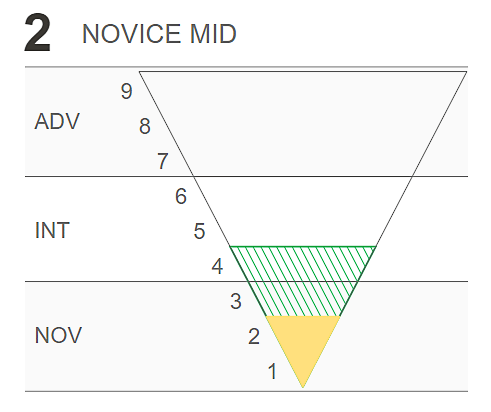
Score Pyramid
An inverted pyramid graphic displays each score. The filled section shows the level reached.
- For Writing and Speaking, an extra shaded area may appear if one response was scored at a higher level.
- This indicates the student may be performing across a range of proficiency levels for that skill.
Skill Descriptions
Next to the pyramid, you’ll see descriptions of the skill (Writing and Speaking) and the level category (Novice, Intermediate, Advanced).
- If a test section wasn’t finished, this area will instead show the status: Not Started or In Progress.
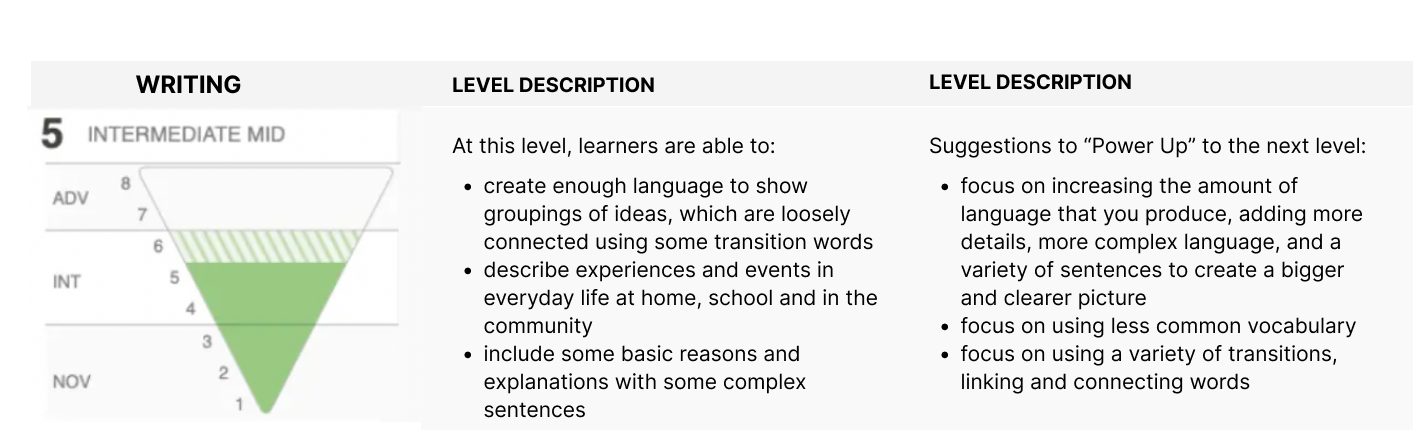
Power Up Suggestions
On the far right, the report lists Power Up Suggestions—practical tips the student can use to improve and reach higher scores in that skill.
Understanding the Scores
The Individual Report shows the score earned for each skill, along with a Composite Score.
Score Pyramid
An inverted pyramid graphic displays each score. The filled section shows the level reached.
- For Writing and Speaking, an extra shaded area may appear if one response was scored at a higher level.
- This indicates the student may be performing across a range of proficiency levels for that skill.
Skill Descriptions
Next to the pyramid, you’ll see descriptions of the skill (Reading, Writing, Listening, Speaking) and the level category (Novice, Intermediate, Advanced).
- If a test section wasn’t finished, this area will instead show the status: Not Started or In Progress.
Power Up Suggestions
On the far right, the report lists Power Up Suggestions—practical tips the student can use to improve and reach higher scores in that skill.
To understand more about the Individual Report scores, see the Benchmark and Rubric Guide. The rubric outlines in detail what expectations are placed upon the test takers for performance at any given level. For more information about a specific test taker’s scores, contact the organization that administered the test.